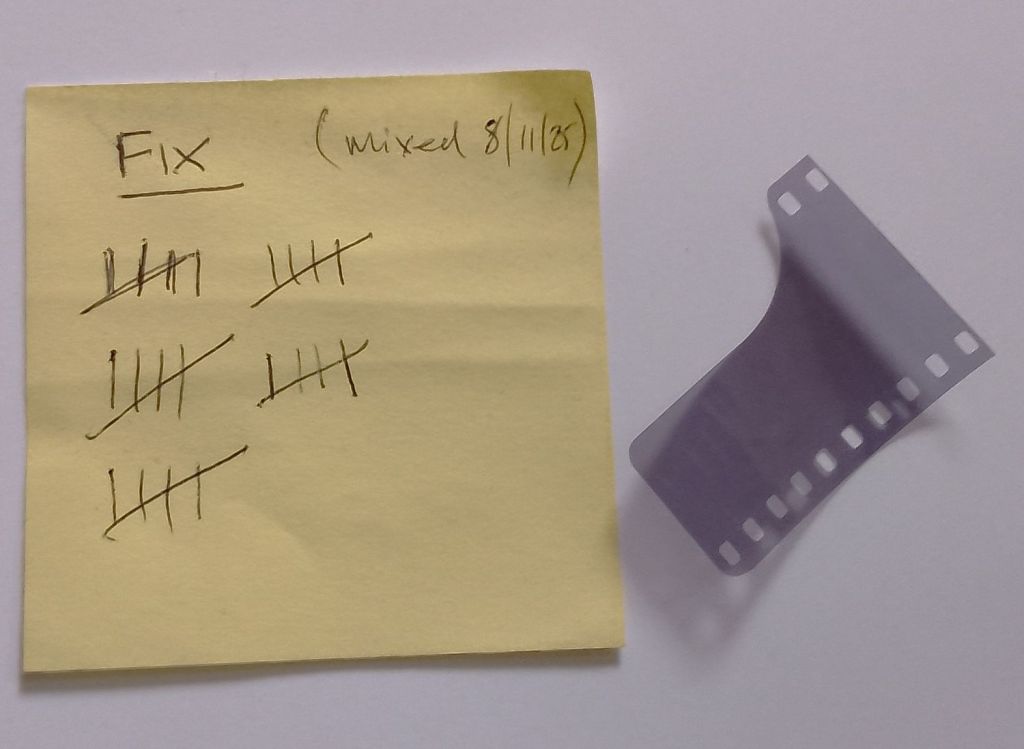
I was chatting to a fellow the other day who was bemoaning the cost of fixer, compared to the other chemicals for processing black and white film. I must have been looking at him blankly as he said “you disagree?” I laughed and said “well -yes!”. After a couple of questions it transpired that he uses Ilfosol which he dilutes 1+14, develops then dumps. He uses a stop bath, then dumps, fixes the film then dumps. … “and that my friend is why it’s costing you!” I replied – this is what I explained I do…
I mix all the chemicals, sit them in a water bath (a plastic storage box, with 20 degree water), I load the film onto the spiral and into the tank. I tend to get hold of the end first, if the camera winds it right back in (as the Canon EOS 30 does – I get it back out!). I cut the end square, and trim the corners just a tiny bit to avoid any snagging. In fact I also get the film started on the spiral, it just saves 10 seconds in the dark bag! I keep the bit I chopped off!
Back at the sink I check the temp of the dev, I go when I’m within half a degree either side of 20c. I don’t bother to check the temp of the fix, it’s in the same water bath, it will be fine! What I do check is that the fixer is OK. I throw the end that I kept into the mixing graduate, pour fix over it, and time how long it takes to clear. For example, fresh Ilford Rapid Fix (I always use) at 1+4 (200ml + 800ml water – I always mix a litre), takes about 40 seconds to clear standard FP4, Delta and other T grain films will take longer. When the film clears this tells me that my fix is good.
I develop the film, stop, pour in the fix. My little test at the start tells me the fix is good, but if I know it took say 40 secs to clear, I’d fix it for twice that only. “Twice the clearing time”. In that example 80 secs. Any more than that, it is possible to loose (fix out) some very subtle tones. You have to go extreme, but it is possible to fix too much!
Anyway, critically and back to the point of this post, I then pour the fix back into the bottle for re-use next time.
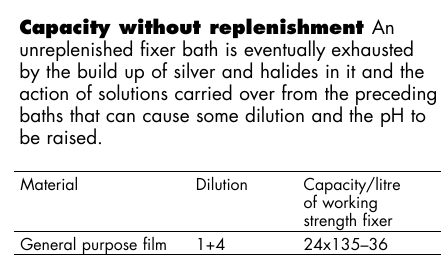
Yes, I do need to perform a 30 second test, but it’s nice to know that even fresh fix is working as it should rather than just trust! Bi products from the films also build up. Least harmful but more noticeable is dye. First film I developed in my sparkly new fresh fix was a TMAX 100, it went back into the bottle quite pink – but it will be fine. Silver Iodide, we can’t see and in my experience that is what exhausts the fix more than time. I find with my little test, I get about 25 rolls of film through one litre of mixed, ready to use, Ilford Rapid Fix. Ilford’s Data Sheet suggests 24. I’m happy to accept their better knowledge of such things.
Give or take, Ilford’s Rapid Fix is about £20 a litre, at 1+4 that makes 5 litres – ready to use. At 24 a litre that’s 120 films per bottle, 17p per film – hardly expensive!
 S.H.O.U.T.
I’ve always tossed my fixer after about a dozen rolls. Maybe I can push that a little farther after reading this!
LikeLike
I use Hypo Check to check mine, so I don’t have to guess or just toss.
LikeLike
My 1 litre of mixed fixer has a label attached where I mark off each time it’s been used. I don’t tend to test it until it’s been used around 15 times, then I do so just to be on the safe side.
Stop bath is the same.
The only things I don’t reuse are the developer and rinse-aid.
LikeLike