
The Olympus OM4 is claimed to be the successor to the much loved OM2n, that I feel needs a little explanation as of course there is an OM3! The OM 4 was manufactured between 1983 and 1987, while the OM3 1983-86. The ‘4 is considered the successor as it’s an “auto” camera and offers a such a mode, just like the 2n. This also makes it “battery dependant” something that purists seem to get their knickers in a twist about. I’ve never really understood that argument. All film cameras are “film dependant” if you want to keep shooting you need enough film for your needs – you act accordingly. Cars are petrol/diesel dependant – if you don’t put enough in – you stop moving! Why the fuss about batteries? Anyway, mini rant over – for those who get excited about such things, the OM3 was purely mechanical, sort of an Olympus “FM2n”. At the time it was much more expensive than the OM1 which was still available, and also manual. It also had a shorter production time, and so sold in much lower numbers. The 3 is therefore rarer and now fetches a much higher price.
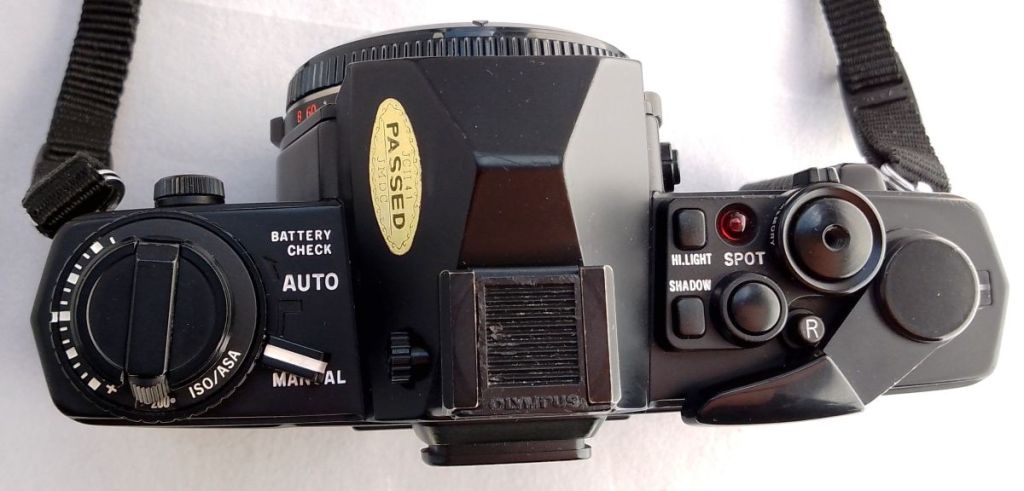
Compared to the OM2n the main obvious difference is the exposure system. It’s the first camera that I have owned that has arrived with a separate manual for the exposure system! It has a muti-spot meter claimed to be (2% of view; 3.3˚ with 50 mm lens) . It’s possible to take up to 8 spot readings and let the camera average them out! In practice, with modern film latitude, over a scene, where that gets you compared to a wider average, I’m not sure or convinced. However, perhaps more useful is that it has a “Shadow” and “Highlight” button for dialling in those spot readings. In other words if one has a dark subject, the exposure will make an allowance for that rather than trying to make it 17% grey (Zone 5). I assume it doesn’t “open up” the aperture by a stop or so, to needlessly lighten it. Likewise the “highlight” button, doesn’t “close down” to darken the scene. There is also an AE lock, One point spot, and memory lock. The example given for that is a multi shot panoramic exposed evenly across all frames.
Other improvements over the OM2n are that the hot shoe is finally part of the camera and not an add on. There is a better attempt at making it a little more waterproof, there is an LCD for exposure in the viewfinder rather than the needle, stronger chassis and a TTL flash socket. A fair old up-date then!
I’m going to have to put a film through it and play with the meter system. I’m hoping that in use it will make more sense to me than reading through the instruction book! As soon as some decent weather corresponds with my day off – I’ll be off out! It also has a multiple exposure facility, I may have a little play with that too! So now I have an OM1n, OM2n and a OM4…. I know what you’re thinking and no I have no “intention” of buying a 3 (in January 2026)!
 S.H.O.U.T.