
I haven’t been enthused about trying any new cameras recently, in fact I’ve been more in the mind of using what I know and really getting to know it better. A few weeks ago however I was gifted a Fujica Compact 35, and that broke the mould and made me want to try it out.

The viewfinder is large and bright, and displays focus, shutter speed and aperture – better than an Olympus Trip! Once open it’s the usual procedure. Very easy to load, and positive. I loaded a roll of FP4+. In the image to the left you can see above the take up is a ISO selector, this calibrates the selenium cell type meter. The rotary dial, does nothing – it’s just a memo to help remember what film you’ve loaded. The fact it offers 20exp gives it’s age away!
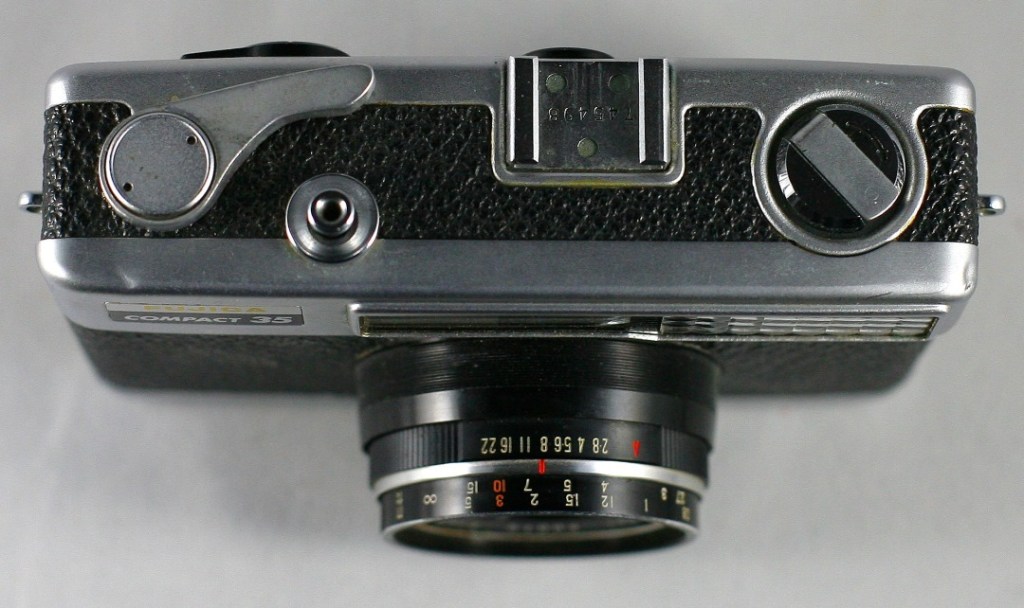
The top plate offers little – shutter release, to which one can add a mechanical cable release. Rewind lever and wind on lever. Apart from the “cold” shoe, that’s it! For flash, there is a PC socket to the bottom right of the lens as you look at the front of the camera.

The base is as clean as the top. Tripod socket, rewind release and frame counter. It’s under the lens that is more interesting as it lets the operator select a manual shutter speed, 250th down to 30th, B and Auto which is also the flash sync.
On top the lens it’s possible to set both aperture and focus manually, meaning it can be used totally manually. In fact there are no batteries! The lens is a 38mm (3.8 cm as marked) f2.8 Fujinon. Unfortunately my example has a little haze in it. As far as I can see the camera is all metal, that means that it weighs close to 400g, but has a feeling of being well built. This original version was released in 1966 – slightly older than me! A “New” and a “Light” version followed, and in 1970 a fourth version, all pretty much the same, just shaving 40g off the weight, offering coloured leatherette and finally a “hot” shoe.

I decided not to trust the 58 (!) year old meter, and set my shutter speed at 60th and the lens to f5.6 and shot away. I took it with me to my weekly breakfast out at the local garden centre and made photo’s under the canopy, where Christmas tree sales were underway.


The focus is the front ring of the lens and is continuous, as is the indicator in the viewfinder. When one gets the distance about right, the camera produces sharp images. FP4 at 125iso was perhaps the wrong choice. HP5 at 400 would have allowed me to have a smaller aperture, with more depth of focus to play with and a higher shutter speed to avoid camera movement. I needed to push the shutter release down quite a way and that led to a couple of blurred shots.

In summary I liked just about everything this camera offered. At the moment they seem to sell for between £40-£60 on ebay, however it’s not difficult to find one for £20 – £25 and at that price I’d say it was a bargain!
 S.H.O.U.T.
NIce. Fuji(ca)s seem to be a blind spot in my vintage camera knowledge, though I had a much-later DL-100 for a hot second. I like the rounded edges that seem to be a mid 60’s thing. It reminds me of my Canon Demi EE17, which is currently off for a CLA.
LikeLiked by 1 person
Hi! If I’m honest I wouldn’t have purchased it – but when it was gifted to me it looked too good not to try, and I was impressed. I liked the fact that it has proper manual options. Rather like a good old original Olympus Trip but with proper manual and without the stupid price tag! – Cheers Andy
LikeLike