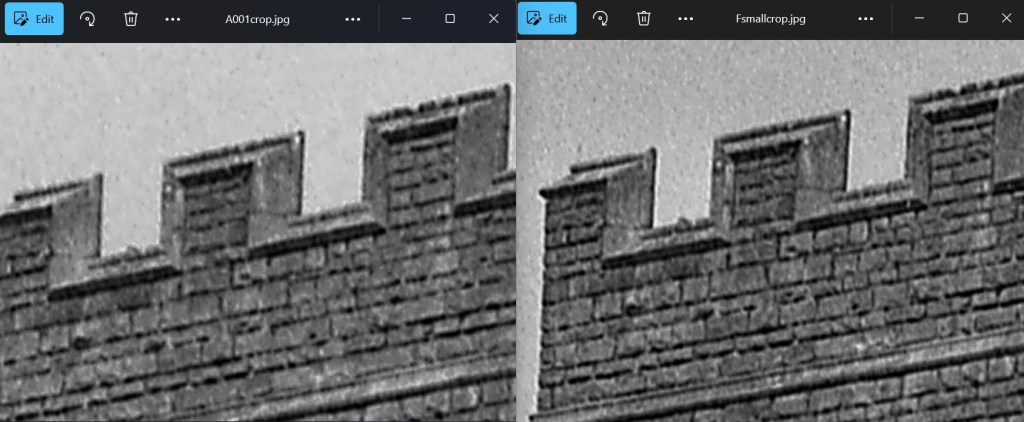
For those of you who have been following my recent developer mini tests, I tried Rodinal 1+100. Another clip of the same film, 20 degrees, this time 1+100, 30mins, (semi-stand) agitating for 30 seconds at the start. Another 15 secs at the 15 minute mark, then pour out at 30. Again the grain is worse – I can see no gain, but I can see more grain!
Treated exactly the same in the scanning process of course. Negs on the light box look about the same but when magnified like the above, one can see the grain. I suppose it’s true that the tiny bit of the negative above would be like printing the whole neg something like 16×20 inches, (too big for 35mm anyway?). An 8×10 may be fine. That said, better results at 1+50, shorter time stood at the sink – if I use Rodinal again – it’ll be 1+50 !!!

 S.H.O.U.T.
Have you tried PC-TEA?
LikeLiked by 1 person
Sorry, that was a very short comment, above. I wasn’t sure if I was logged in, so that was a test message 😉
I read your FX-55 post with interest. I have experimented with Phenidone / Vitamin C developers, too. and found the results to be very good. What puzzled me very much was that Vit C seems to be just as useful as a developer as hydroquinone whilst being much cheaper, easier to obtain and a lot less toxic – yet we persisted with “Q” for such a long time before anyone started using Vit C. I’ve just googled Vit C and Wikipedia tells me: “Vitamin C was discovered in 1912, isolated in 1928 and synthesized in 1933”. Hydroquinone goes back to 1820 – so it is older than the photographic process and its use would have been very well established before anyone thought of using Vit C. Maybe that is the reason?
I looked up the formula for FX-55 and it was water based. I assume you must have a revised / upgraded version if it is in glycol? You are probably familiar with the work of the late Patrick Gainer? It was after discovering him on APUG that I tried his glycol / Vit C / Phenidone developers and was very pleased not only with the results, but with the promise that the keeping qualities would compete with Rodinal!
Later I mixed up PC-TEA, which has only three ingredients – Phenidone, Vitamin C and Triethanolamine (TEA). This is so simple, almost none toxic (phenidone is slightly toxic but is in tiny amounts) and TEA is used widely in cosmetics, people rub it on their skin all the time – so ultra safe, no allergic reactions, it promises to keep indefinitely and the results are really good. I mixed up a batch about two years ago, so I’ll be able to report back on its keeping qualities next time I use it.
I won’t say any more in case you’re already familiar with it, but if you like FX-55 and haven’t tried PC-TEA yet, I would definitely give it a go!
LikeLiked by 1 person
Hello!
Yes I’ve heard of PC-TEA but not used it. I do have John Finch’s book and the recipe is in there. Another developer to try!!
I made up the Gainer (Glycol) Part B version of FX55 as, to be honest (and lazy) I can’t be bothered to measure small amounts of dry chemicals while getting ready to process a film. Where as 6ml of part B with a syringe is just the same as mixing up some Rodinal! I’m very pleased with the results I’ve got from it, and will try a couple of other emulsions in it soon to see if they are a good match too. I’ll stick with it until I’ve used up this batch! I also like the low toxicity angle too – better for everyone in the end!
It is strange that we have stayed so long with Hydroquinone, I think I’m correct in saying that it’s still in Ilfosol 3. Certainly in in PQ universal! For that matter I wonder why people are still keen on Pyrogallol – pretty nasty stuff!
I think I’m sold on FX55 – we’ll see!! Like you it’s keeping abilities are important and by all accounts (with the glycol) should keep for ages!!
Cheers – Andy
LikeLike