When someone mentions a “standard lens” most of us automatically think of the “nifty fifty” and indeed for 35mm that is standard. Funny really, as across all formats, it’s the most un-standard! The general rule is that whatever the diagonal of the negative/sensor, that in mm would be the “standard lens” for that format, hence 25mm on a micro 4/3rds camera, 80mm on a 6×6 medium format and so on. The one that is the farthest away from the “rule” is 35mm film being 50mm – it should be 43mm!! The reason for this is that while Oscar Barnak was popularising the use of 35mm motion picture film for use with stills, via Leitz/Leica cameras, Leitz already had a 50mm lens on the drawing board, close enough it was adopted.
Rather than pull back to something closer over time, many have gone the other way! A large number of Spotmatics were sold with 55mm lenses – so too were a lot of Zenith cameras!
When one goes to large format, like everything else – it gets a bit more complex. The “field of view” is considered more into the equation, so that if one does the maths, the long edge (horizontal) gives a different crop factor to the short edge (vertical), and vice versa. That’s why in 5×4 135mm 150mm and 180mm could, and are by many, all considered a standard lens! The 150mm, piggy in the middle, is widely regarded as THE standard.
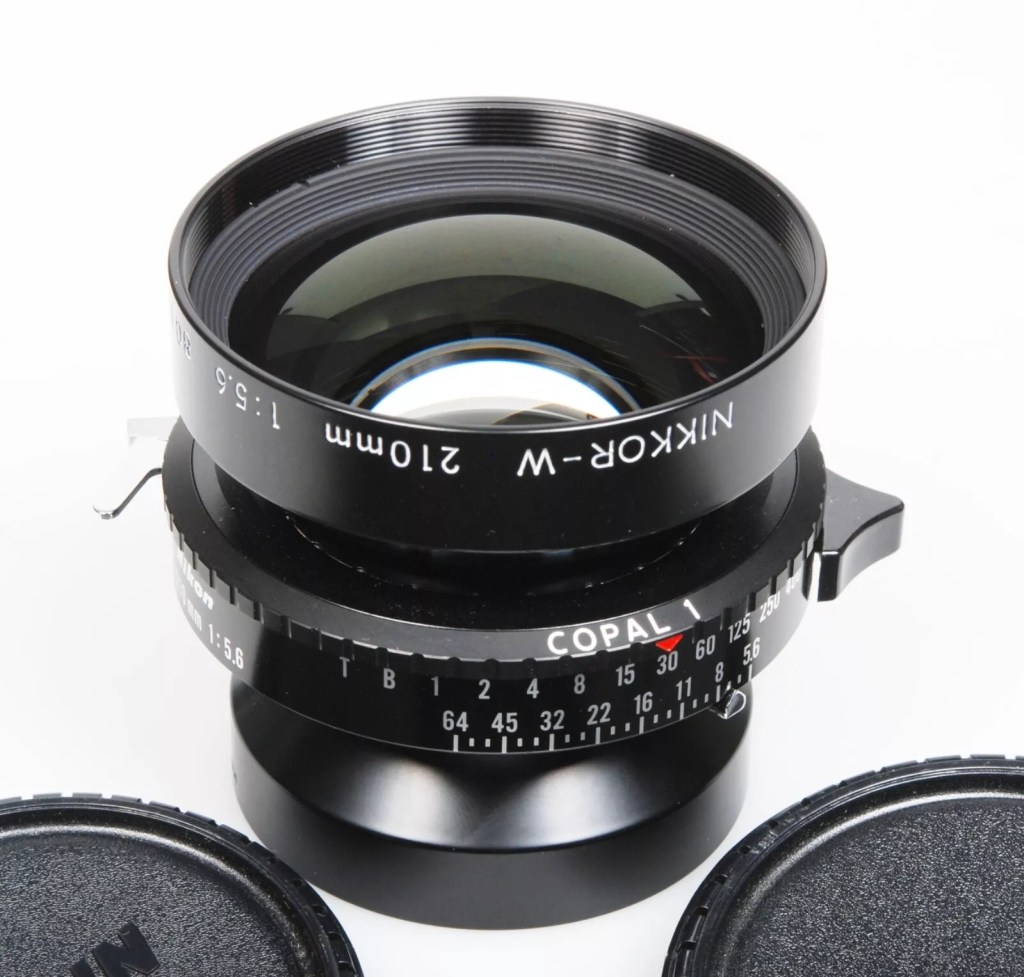
I’ve just purchased a “standard” lens for my 5×7, that is 210mm!! I went for the Nikkor-W f5.6.
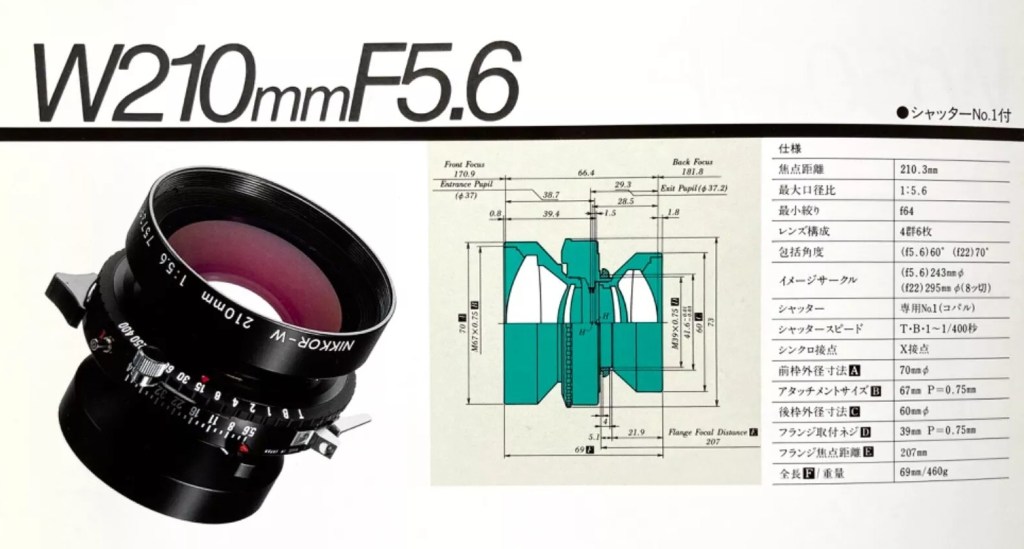
The main things to gleam from the info provided, and maybe the things to look out for when deciding on such a lens are: It’s a f5.6 lens, plenty bright enough for large format, it’s a different game! There are “brighter” lenses but they are huge, heavy and expensive – 3 reason’s I don’t want one! Also of course it’s worth pointing out that although this is the “standard” focal length – it’s still 210mm and a wider aperture will give such a shallow depth of focus I would question it’s usefulness in the real world anyway! This one closes down to f64 – more useful, but as we all know the best part of any lens for quality is about half way – that’s somewhere around f16 -f22, should give a decent depth.
Perhaps equally, maybe more important is “coverage”. One of the main attractions of large format, apart from the quality of image are movements. Shift/Tilt/Rise and so on. To use these without getting vignetting (dark corners!) the lens must produce an image circle that is large enough to cover the film – even when it’s off centre. This lens covers 243mm diagonal at f5.6 and 295mm at f22 – that allows for plenty of movement!
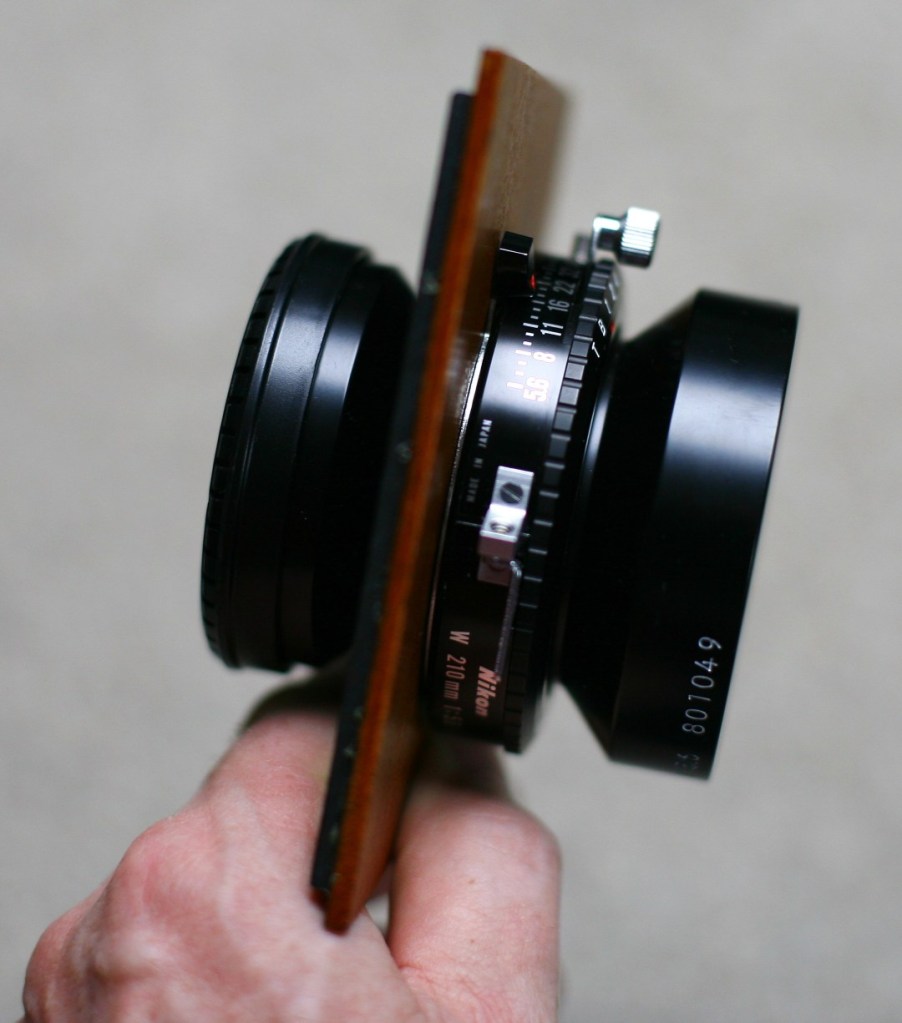
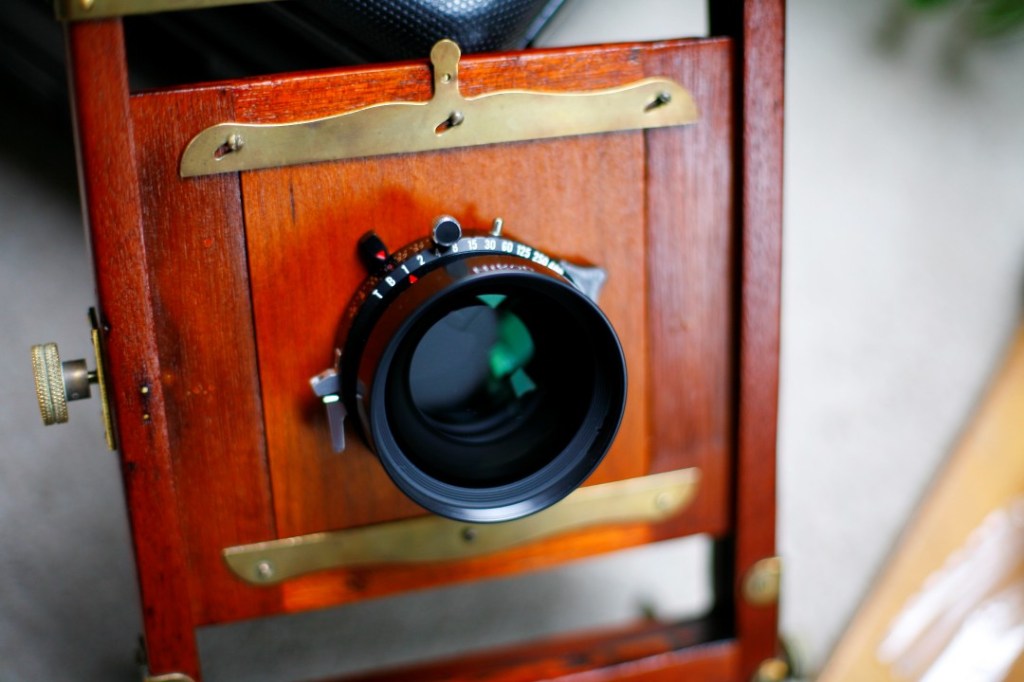
By happy coincidence is has a filter thread of 67mm and I happen to have a full set of black and white filters in my collection that are underused and ready to go! So… I pressed to buy button and 3 days later fitted it to my home made lens board!
 S.H.O.U.T.
The camera is looking really good, be great to see some images when you get it up and running.
LikeLiked by 1 person
Hello! I’m getting there – I now have a box of film!! I have no doubt there will be teething problems but I’m looking forward to the challenge. Of course if I get an image – I’ll share it here! Cheers Andy
LikeLiked by 1 person